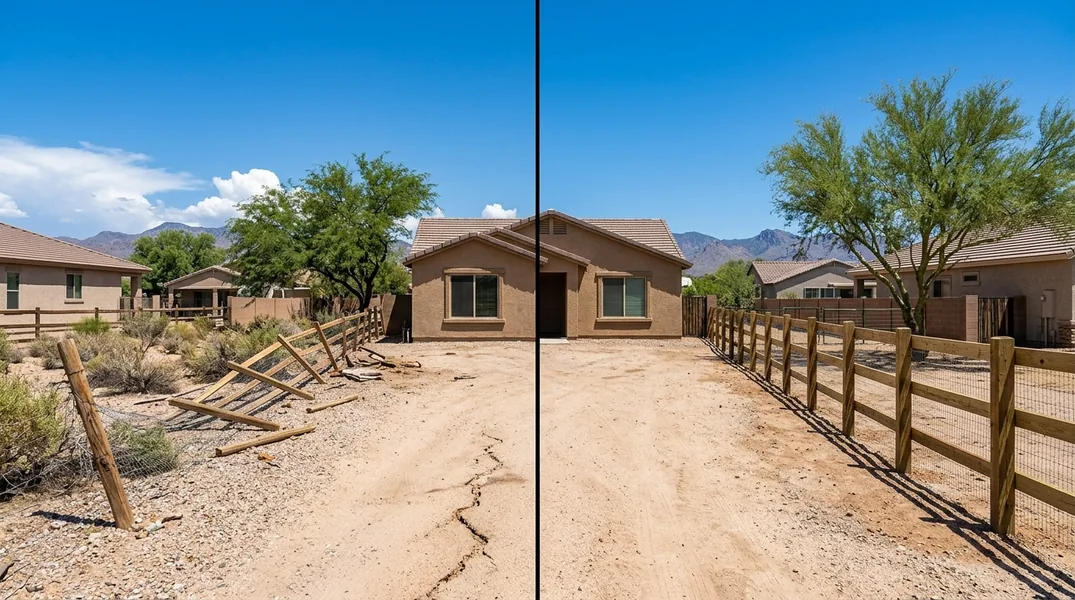
Understanding Monsoon Downbursts and Fence Damage in Tucson
When summer monsoon season arrives in Tucson, homeowners brace for more than just heat and dust. The violent downbursts that accompany these storms can topple fences, snap posts, and leave your property vulnerable in a matter of seconds. A downburst, also called a microburst, is a column of sinking air that spreads outward when it hits the ground, creating winds that can exceed 100 miles per hour. Unlike a tornado, which rotates, a downburst strikes straight down and then spreads horizontally, which is why it's so effective at flattening fences and uprooting trees.
Your fence is often the first casualty of these powerful storms. Wood fences are particularly vulnerable because the wind can catch the large surface area and apply tremendous lateral force to posts that may have weakened over years of sun exposure and monsoon cycles. Even newer Wood & Privacy Fence Installation can fail if the foundation wasn't set deep enough or if the posts weren't properly braced. The damage can range from a few leaning boards to complete sections lying on the ground, and sometimes your neighbor's fence or property is affected as well. Understanding what you're dealing with helps you respond quickly and file insurance claims accurately.
Does Homeowners Insurance Cover Fence Damage from Storms?
This is the question every homeowner in Tucson asks after a monsoon tears through their yard. The answer is: it depends on your policy and the cause of the damage. Most standard homeowners insurance policies do cover fence damage if it results from a covered peril, such as wind, hail, or falling trees. However, coverage varies significantly based on your specific policy language, your deductible, and whether you have any exclusions. Some policies limit fence coverage to a specific dollar amount, often between $500 and $1,500, which may not cover a full replacement of storm damage fence repair for a large property.
The key distinction insurers make is between sudden, accidental damage and gradual wear and tear. If a downburst knocked over your fence, that's typically covered. If your fence was already leaning and weak, and the storm simply finished the job, the insurance company may deny the claim or argue that the damage was pre-existing. This is why it's critical to document your fence's condition before storm season and to take clear photos immediately after damage occurs. Additionally, if a tree falls on your fence, you may have coverage, but if your own tree falls on your neighbor's fence, liability coverage might apply instead. Review your policy now, before the next monsoon hits, and call your insurance agent to clarify what's covered and what your deductible is.
What to Do Immediately After Storm Damage to Your Fence
The first 24 to 48 hours after a storm are crucial for protecting your home and establishing a clear record for insurance purposes. Start by assessing the damage safely. Walk your property perimeter and look for downed sections, leaning posts, broken boards, and any hazards like exposed nails or sharp edges. If a fence section is partially collapsed and poses a danger to children, pets, or passersby, mark it off and consider temporary barriers. Take multiple photos and videos from different angles, showing the overall damage and close-ups of specific problem areas. These images are your strongest evidence when filing an insurance claim.
Next, check for injuries or damage to neighboring properties. If your fence fell on a neighbor's car, fence, or home, you'll need to report this to your homeowners insurance immediately. Many policies require prompt notification, and delays can complicate claims. If you caused damage to someone else's property, be transparent and let your insurance company handle the communication. At the same time, do not make permanent repairs yet. Insurers often want to inspect the damage before you remove debris or replace sections. However, if the damage poses a safety risk, take temporary measures like securing loose boards or removing debris that could injure someone. Document these temporary actions with photos as well, noting that they were emergency measures to prevent further harm.
Filing Your Insurance Claim for Storm Damage Fence Repair
Once you've documented the damage, contact your homeowners insurance company to file a claim. Have your policy number ready and provide a clear, detailed description of what happened. Explain the date and time of the storm, the specific damage to your fence, and any other property damage. Submit your photos and videos along with the claim. Many insurers now allow you to file claims online through their mobile apps or websites, which can speed up the process. Be prepared to answer questions about the age of your fence, any previous damage or repairs, and whether you've had maintenance performed recently.
The insurance company will likely assign an adjuster to inspect the damage in person. This is your opportunity to walk the property with the adjuster and point out all damage, including areas that might not be immediately obvious. Explain how the fence was functioning before the storm and describe the extent of the damage in detail. If you've already received quotes from fence repair contractors, share those with the adjuster as well. The adjuster's assessment will determine the settlement amount. If you disagree with the settlement offer, you have the right to appeal or hire an independent adjuster to review the claim. Keep all documentation, correspondence, and receipts in a folder for your records.
Storm Damage Fence Repair Options: Temporary vs. Permanent Solutions
While your insurance claim is being processed, you'll need to decide whether to make temporary repairs or move forward with permanent restoration. Temporary repairs are appropriate if you're waiting for an insurance adjuster or if you want to minimize costs while the claim is pending. You can reinforce leaning fence sections with braces, replace a few broken boards, or install temporary fencing to secure your property. These measures are cost-effective and allow you to protect your home without committing to full replacement until you know what your insurance will cover.
Permanent repairs, on the other hand, restore your fence to its original condition or better. Depending on the extent of the damage, this might mean replacing individual posts and sections, or rebuilding the entire fence. If your fence is older and sustained significant damage, this is often a good time to consider an upgrade. You might replace aging Wood & Privacy Fence Installation with more storm-resistant materials like Vinyl & PVC Fence Installation, which withstands wind and weather better than traditional wood. Alternatively, Aluminum & Ornamental Iron Fencing offers durability and style. Whatever you choose, make sure the new installation meets current building codes and is properly anchored to prevent future storm damage. Contact Tucson Fence Company at (520) 351-0669 to discuss your options and get a free estimate for repair or replacement.
Preventing Future Monsoon Fence Damage: Maintenance and Upgrades
Once your fence is repaired, take steps to minimize damage from the next monsoon season. Regular maintenance is your first line of defense. Inspect your fence twice a year, looking for soft spots in posts, loose boards, and signs of rot or insect damage. Keep the base of fence posts clear of debris and standing water, which accelerates decay. Trim tree branches that hang over your fence, as these can snap during high winds and damage the fence structure. If you live in a particularly windy area or have experienced repeated storm damage, consider reinforcing your fence with additional bracing or upgrading to a more wind-resistant design.
Modern fence designs can significantly reduce storm damage risk. Vinyl and composite materials are more flexible than wood and can better withstand wind gusts without cracking or splitting. Ornamental metal fences offer excellent strength and durability. If you're rebuilding after storm damage, consult with a professional fence contractor about design options that balance aesthetics with storm resilience. Proper installation is equally important. Posts must be set deep in concrete, typically 24 to 36 inches depending on fence height, and spaced appropriately to distribute wind load. When you're ready to upgrade or repair your fence after storm damage, Tucson Fence Company can help you select materials and installation methods that will protect your property for years to come. Reach out today to learn more about your options and get started with a free estimate.
Looking for a professional fence contractor in Tucson? Tucson Fence Company responds fast for all your fence needs.
Get a Free Quote