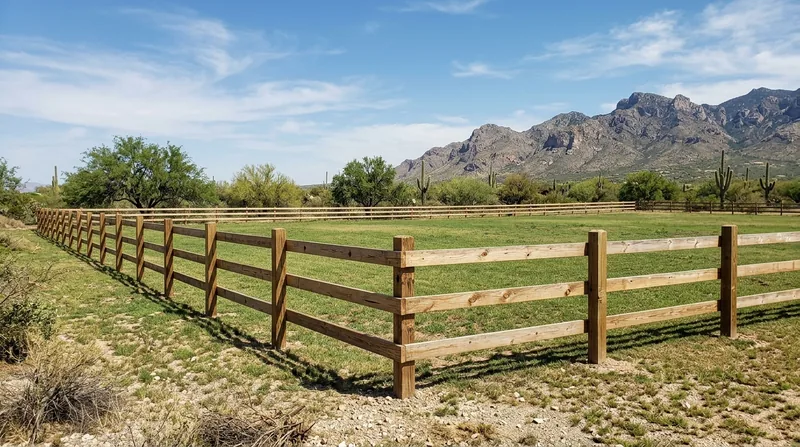




Farm fence installation in Tucson requires a different approach than residential privacy fencing. Acreage across Greater Tucson, from Oro Valley to Sahuarita to Green Valley, sits on caliche hardpan that makes post holes slow and sometimes demands an auger or jackhammer. The relentless desert sun splits untreated wood and fades powder coating far faster than humidity ever rots it in wetter climates. Ranch rail, no-climb horse fence, field wire and pipe fencing need straight lines over long runs, braced corners and gates sized for trailers and equipment. We install and repair fencing for horses, livestock and property boundaries on acreage across the region, with the same crews on every job and honest guidance on repair versus replacement.
Why Farm and Ranch Fencing Matters in Tucson's Desert Acreage
Greater Tucson's low-density housing stock means acreage is common, and that acreage needs containment and security. A residential block wall works for perimeter security, but it does not contain livestock, does not allow visibility into pasture, and does not accommodate the gate sizes that trailers and equipment need. Ranch fencing solves a different problem: it marks the line, contains animals, allows you to see across your land, and opens wide enough to move hay, feed, and equipment. The desert terrain makes installation slower than it would be in clay or loam, and the sun makes material choice critical. A fence that looks good in year one can split and fade badly by year three if it is not built and finished for this climate.
- Post holes in caliche often need power equipment to reach proper depth and frost line, adding time and cost to the job.
- Wood must be pressure-treated pine or cedar, set in concrete to resist ground-line failure from sun and dry cycles, not rot.
- Pipe and field wire fencing needs galvanized or powder-coated metal to prevent rust and fading over years of exposure.
- Gates for ranch use must be wider and stronger than residential gates, with self-closing and self-latching hardware to prevent livestock escape.
- Braced corners and anti-sag bracing hold straight lines over long runs where wind and animal pressure test the structure.
The difference between a fence that holds and one that fails is the design and the finish chosen for this climate.
Key info: In Tucson and Sahuarita, many acreage properties sit in unincorporated Pima County, where setback and height rules differ from city limits. Verify requirements with Pima County Development Services before you order materials. Deed restrictions and HOA architectural standards also govern some master-planned acreage communities.
For more on the materials we use, see our wood fence installation and metal fencing pages.
How We Install Ranch and Farm Fencing in Tucson
Farm and ranch fencing starts with the ground and the line. We work from your existing survey or the line you identify, and we call 811 before we dig any post hole. Arizona law requires utility locates to mark underground power, gas, water and irrigation lines before digging. Once the line is marked and utilities are located, we lay out posts at the correct spacing, set them in concrete to resist the desert ground cycle, and install rails, wire or pipe to the height and specification you need.
The process differs by material and terrain, but the principle is the same: straight lines, proper depth, and finishes that hold in the Tucson sun.
- We locate the fence line using your survey or your identification, and call 811 for utility locates before any digging begins.
- We lay out post locations at spacing appropriate to the material (typically 6 to 8 feet for ranch rail, 5 feet for pipe fence, 6 feet for field fence).
- We dig or auger post holes to depth, or use a jackhammer if caliche is too hard, and set posts in concrete for ground-line stability.
- We install rails, pipe or field wire to the height and specification you need, with bracing at corners and gates sized for equipment.
- We finish all exposed wood with a UV-protective sealant, and all metal with galvanized or powder-coated coating to resist fading and rust.
The key is starting with the ground and the line, so the fence stands straight and holds for years.
Example: A 5-acre property in Marana with a split rail fence around the perimeter runs roughly 1,200 linear feet. Caliche at 18 inches means we auger or jackhammer each of the 150 post holes, set them in concrete, install three rails on each side, and seal the wood. The job takes 4 to 6 days depending on caliche depth and weather. A no-climb horse fence on the same line takes longer because the mesh is woven tight and the wire must be tensioned properly.
For gate installation and repair on your ranch, see our gate services page.
Materials and Methods for Farm and Ranch Fencing
| Approach | Description | Best for |
|---|---|---|
| Split Rail Fence | Pressure-treated or cedar rails mortised into posts, typically two or three rails high, posts set in concrete at 6 to 8 foot spacing. | Property boundaries, decorative fencing, low containment, horse pastures where visibility is important. |
| No-Climb Horse Fence | Vinyl or wire mesh woven tight and stapled to wood posts and rails, preventing hooves from catching, typically 4 to 5 feet high. | Horse pastures, livestock containment, areas where animal safety and visibility both matter. |
| Pipe Fence | Galvanized or powder-coated steel pipe welded to posts, typically 2 to 3 inches diameter, posts set in concrete at 8 foot spacing. | High-traffic areas, livestock containment, durability and low maintenance, large gates for equipment. |
| Field Wire Fence | Galvanized wire mesh stapled to wood posts, typically 4 to 6 feet high, posts set in concrete at 6 foot spacing, often combined with one or two top rails. | Livestock containment, pasture division, cost-effective perimeter fencing, areas where visibility is needed. |
| Barbed Wire Fence | Galvanized barbed wire strung between wood or pipe posts, typically 4 to 5 strands, posts set in concrete at 6 to 8 foot spacing. | Cattle and livestock containment, boundary marking, low cost, areas where appearance is less critical than durability. |
Farm and Ranch Fencing Cost in Tucson: What to Expect
Farm fence installation in Tucson pricing depends on material, terrain, and the length of the run. Split rail and no-climb horse fence typically start at $12 to $18 per linear foot installed, pipe fence at $18 to $28 per linear foot, and field wire at $8 to $14 per linear foot. These figures assume posts set in concrete, proper bracing, and finishes rated for the desert sun. The biggest variable is the ground: caliche that requires an auger or jackhammer adds $2 to $5 per post hole, and a 5-acre property with 150 post holes feels that cost quickly.
Gates add to the total. A single-swing ranch gate 10 to 12 feet wide runs $400 to $800 installed. A cantilever gate or a V-track sliding gate for larger equipment runs $800 to $1,500 or more. Long runs with multiple gates and braced corners are best quoted on-site, because the terrain and your specific needs shape the price more than a generic estimate can.
Get 2 to 3 estimates from installers who have worked acreage in Pima County and know caliche, so you can compare material choices and method. A cheap estimate often means shallow post holes or no concrete, which fail in the first monsoon season or when an animal leans on the fence.
Call us at (520) 351-0669 for a free estimate. We visit the site, look at the ground, mark the line, and give you a realistic price based on what we see. See our full pricing page for more detail on what drives the cost.
Farm and Ranch Fencing Near Me: What Tucson Homeowners Should Know Before Hiring
Hiring a fence contractor for acreage is different from hiring one for a residential yard. You need someone who understands caliche, knows how to brace long runs, and can build gates that hold up to daily use. You also need to understand the legal requirements in your area, because farm and ranch fencing rules vary across Greater Tucson.
Arizona requires a Registrar of Contractors license, classification R-14 Fencing, for fence work once labor and materials exceed $1,000, and regardless of price whenever a building permit is required. Check with your city or county planning department to learn whether your project needs a permit. In unincorporated Pima County, most acreage fencing does not require a permit, but deed restrictions or an HOA may govern height, material and color. Ask before you start. Verify setback and height rules with the local building department, because they vary by jurisdiction.
When you call a contractor, ask for proof of general liability and workers' compensation insurance, and request a certificate of insurance naming your property. Ask for references from recent acreage jobs in your area, and call them. Ask whether the contractor has done caliche and how they handle it. Get the estimate in writing with material specifications, post spacing, gate sizes and finish details, so you know exactly what you are paying for.
For a free estimate and honest guidance on your project, contact us at (520) 351-0669.
Farm & Ranch Fencing in Tucson: Pricing Guide
| Service | Price | Details |
|---|---|---|
| Split Rail Fence | Starting at $12/ft | Pressure-treated or cedar rails mortised into posts, installed with concrete-set posts, includes UV-protective sealant on wood |
| No-Climb Horse Fence | Starting at $14/ft | Vinyl or wire mesh woven tight on wood posts and rails, 4 to 5 feet high, installed with concrete-set posts and anti-sag bracing |
| Pipe Fence | Starting at $18/ft | Galvanized or powder-coated steel pipe welded to posts, 2 to 3 inches diameter, posts set in concrete, suitable for livestock and high-traffic areas |
| Field Wire and Barbed Wire Fence | Starting at $8/ft | Galvanized wire stapled or strung on wood or pipe posts, posts set in concrete, cost-effective containment for cattle and livestock |
| Gates and Braced Corners | Starting at $400 | Single-swing ranch gates 10 to 12 feet wide, cantilever and V-track sliding gates priced on-site depending on size and equipment access needs |
| Caliche Drilling and Jackhammer Work | On estimate | Desert hardpan often requires auger or jackhammer to reach proper post depth, adding $2 to $5 per hole depending on depth and hardness |
Indicative pricing, the exact cost depends on square footage, finish, and site access. Free personalized estimate within 24h at (520) 351-0669.


